
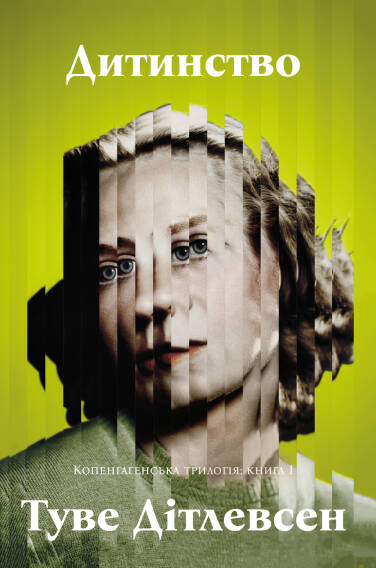
Childhood is long and narrow like a coffin, and you can’t get out of it on your own. It’s there all the time and everyone can see it just as clearly as you can see Pretty Ludvig’s harelip. It’s the same with him as with Pretty Lili, who’s so ugly you can’t imagine she ever had a mother. Everything that is ugly or unfortunate is called beautiful, and no one knows why. You can’t get out of childhood, and it clings to you like a bad smell. You notice it in other children – each childhood has its own smell. You don’t recognize your own and sometimes you’re afraid that it’s worse than others’. You’re standing talking to another girl whose childhood smells of coal and ashes, and suddenly she takes a step back because she has noticed the terrible stink of your childhood. On the sly, you observe the adults whose childhood lies inside them, torn and full of holes like a used and moth- eaten rug no one thinks about anymore or has any use for. You can’t tell by looking at them that they’ve had a childhood, and you don’t dare ask how they managed to make it through without their faces getting deeply scarred and marked by it. You suspect that they’ve used some secret shortcut and donned their adult form many years ahead of time. They did it one day when they were home alone and their childhood lay like three bands of iron around their heart, like Iron Hans in Grimms’ fairy tale, whose bands broke only when his master was freed. But if you don’t know such a short- cut, childhood must be endured and trudged through hour by hour, through an absolutely interminable number of years. Only death can free you from it, so you think a lot about death, and picture it as a white- robed, friendly angel who some night will kiss your eyelids so that they never will open again. I always think that when I’m grown- up my mother will nally like me the way she likes Edvin now. Because my childhood irritates her just as much as it irritates me, and we are only happy together whenever she suddenly forgets about its existence. Then she talks to me the way she talks to her friends or to Aunt Rosalia, and I’m very careful to make my answers so short that she won’t suddenly remember I’m only a child. I let go of her hand and keep a slight distance between us so she won’t be able to smell my childhood, either. It almost always happens when I go shopping with her on Istedgade. She tells me how much fun she had as a young girl. She went out dancing every night and was never o the dance oor. ‘I had a new boyfriend every night,’ she says and laughs loudly, ‘but that had to stop when I met Ditlev.’ That’s my father and otherwise she always calls him ‘Father’, just as he calls her ‘Mother’ or ‘Mutter’. I get the impression there was a time when she was happy and di erent, but that it all came to an abrupt end when she met Ditlev. When she talks about him it’s as if he’s someone other than my father, a dark spirit who crushes and destroys everything that is beautiful and light and lively. And I wish that this Ditlev had never come into her life. When she gets to his name, she usually catches sight of my childhood and looks at it angrily and threateningly, while the dark rim around her blue iris grows even darker. This childhood then shivers with fear and despairingly tries to slip away on tiptoe, but it’s still far too little and can’t be discarded yet for several hundred years.
People with such a visible, agrant childhood both inside and out are called children, and you can treat them any way you like because there’s nothing to fear from them. They have no weapons and no masks unless they are very cunning. I am that kind of cunning child, and my mask is stupidity, which I’m always careful not to let anyone tear away from me. I let my mouth fall open a little and make my eyes completely blank, as if they’re always just staring o into the blue. Whenever it starts singing inside me, I’m especially careful not to let my mask show any holes. None of the grownups can stand the song in my heart or the garlands of words in my soul. But they know about them because bits seep out of me through a secret channel I don’t recognize and therefore can’t stop up. ‘You’re not putting on airs?’ they say, suspiciously, and I assure them that it wouldn’t even occur to me to put on airs. In school they ask, ‘What are you thinking about? What was the last sentence I said?’ But they never really see through me. Only the children in the courtyard or in the street do. ‘You’re going around playing dumb,’ a big girl says menacingly and comes up close to me, ‘but you’re not dumb at all.’ Then she starts to cross- examine me, and a lot of other girls gather silently around me, forming a circle I can’t slip through until I’ve proved I really am stupid. At last it seems clear to them after all of my idiotic replies, and reluctantly they make a little hole in the circle so I can just squeeze through and escape to safety. ‘Because you shouldn’t pretend to be something you’re not,’ one of them yells after me, moralistic and admonishing.
Childhood is dark and it’s always moaning like a little animal that’s locked in a cellar and forgotten. It comes out of your throat like your breath in the cold, and sometimes it’s too little, other times too big. It never ts exactly. It’s only when it has been cast o that you can look at it calmly and talk about it like an illness you’ve survived. Most grownups say that they’ve had a happy childhood and maybe they really believe it themselves, but I don’t think so. I think they’ve just managed to forget it.